
Choosing Not Choosing
Against the Exceptionalization of HIV in/and Palestine

In his opening remarks to the International Court of Justice last January, Israel’s appointed representative Tal Becker stated that he was “singularly aware of why the Genocide Convention, which has been invoked in these proceedings, was adopted,” citing “the systematic murder of six million Jews as part of a pre-meditated and heinous program for their total annihilation.”
Glaringly absent from Becker’s defense was any mention of the some five million Romani, Communist, Black, disabled, and reputedly sexually deviant lives—among innumerable others—extinguished in the name of Naziism, let alone the Herero and Nama peoples decimated by Germany well over a decade before the National Socialist Party’s foundation. Becker’s speech lays bare the pivotal role that scarcity models—what I call “triage logics”—play not only in the Zionist project, but in all -isms and -phobias that award or withhold care, attention and value on the basis or condition of perceived exceptionality. By exceptionality, I mean the singling out of something or someone—whether a genocide, a state, or an individual—as superlative, i.e. most: “...likely to succeed,” “important,” “tragic,” “inhumane,” “cruel,” “unthinkable.”
If the Shoah (by which I am referring specifically to the Jewish experience of the Holocaust) has indeed been, in Becker’s words, “seared” in both collective memory and international law as a genocide par excellence, the singular standard against which all other allegations of ethnic cleansing are sized up, then so too is HIV/AIDS upheld—at least within hegemonic queer culture—as the most cut-and-dry, quintessential, or politicized state-sanctioned viral episode in modern history.
Along with the macroscopic privileging of certain genocides and viruses as holding more historical or affective heft than others, an analogous stratification also occurs on the micro scale of individual victims. Just as Ashkenazi (or non-Iberian, Euro-descendent) Jews, for instance, have received a disproportionate share of memorializations, reparations and protections since the fall of the Third Reich, from dedicated task forces to combat institutional antisemitism to a Jewish ethnostate in occupied Palestine, so too do white-adjacent cis gay men—particularly those hailing from large, Western metropoles like Paris, New York and San Francisco—figure as both the foremost cultural bearers of the AIDS crisis and the primary beneficiaries of resultant treatments and campaigns like PrEP.
Once you attune yourself to triage logics, you begin to notice them everywhere: in the systematic sidelining of Black and Jewish criticisms of anti-Blackness and antisemitism within pro-Palestinian spaces; in the unrelenting fixation on the deaths of “womenandchildrenandqueers” to the passive villainization and dehumanization of Palestinian men; in the foregoing of COVID precautions among HIV+ activists; in the dismissal of the Sudanese, Congolese, Haitian, Armenian and Chinese Uyghur plights as secondary to that of the Palestinians; in the routine ostracization of victims and protection of serial abusers for the sake of “unity” and numbers in socialist spaces; in the response of a former editor of mine after I politely asked her to refrain from using any variation of the r-slur on her Instagram (even if her “fucking libt**d” of a date was a racist Zionist): “There’s a fucking genocide going on. Is this really what you want to focus on right now?”
The cruel irony to triage logics is that even their intended beneficiaries suffer from their excess violence. “Peoples do not live on exception,” as Martinician luminary Édouard Glissant reminds us. For all the material and immaterial protections that are conferred to Jews, gay men, the HIV+, or Palestinians, a target is simultaneously placed on their backs, undermining the capacity to forge meaningful solidarity networks with the “unexceptional.” One study on HIV/AIDS interventions by Western nonprofits in Mozambique, for example, found that the deliberate sense of resource scarcity introduced by colonial enterprises in already impoverished communities end up inadvertently stoking existing resentments towards people with HIV/AIDS. As one seronegative interviewee put it, “‘why is it that the HIV-positive benefit from all these projects? Don't those of us who are healthy deserve anything?’”
Funnily enough, the piece that that ableist editor published of mine—an interview conducted by my friend and collaborator Joselia Rebekah Hughes—in many ways anticipated the very stakes that would cause our rift all these years later:
I’m always trying to push two words into the same space-time, which I know you can’t do because you always have to make the choice, you have to prioritize. That’s what it means to have executive function: to have the capacity to choose who lives and who dies, right? Which lines to cut.
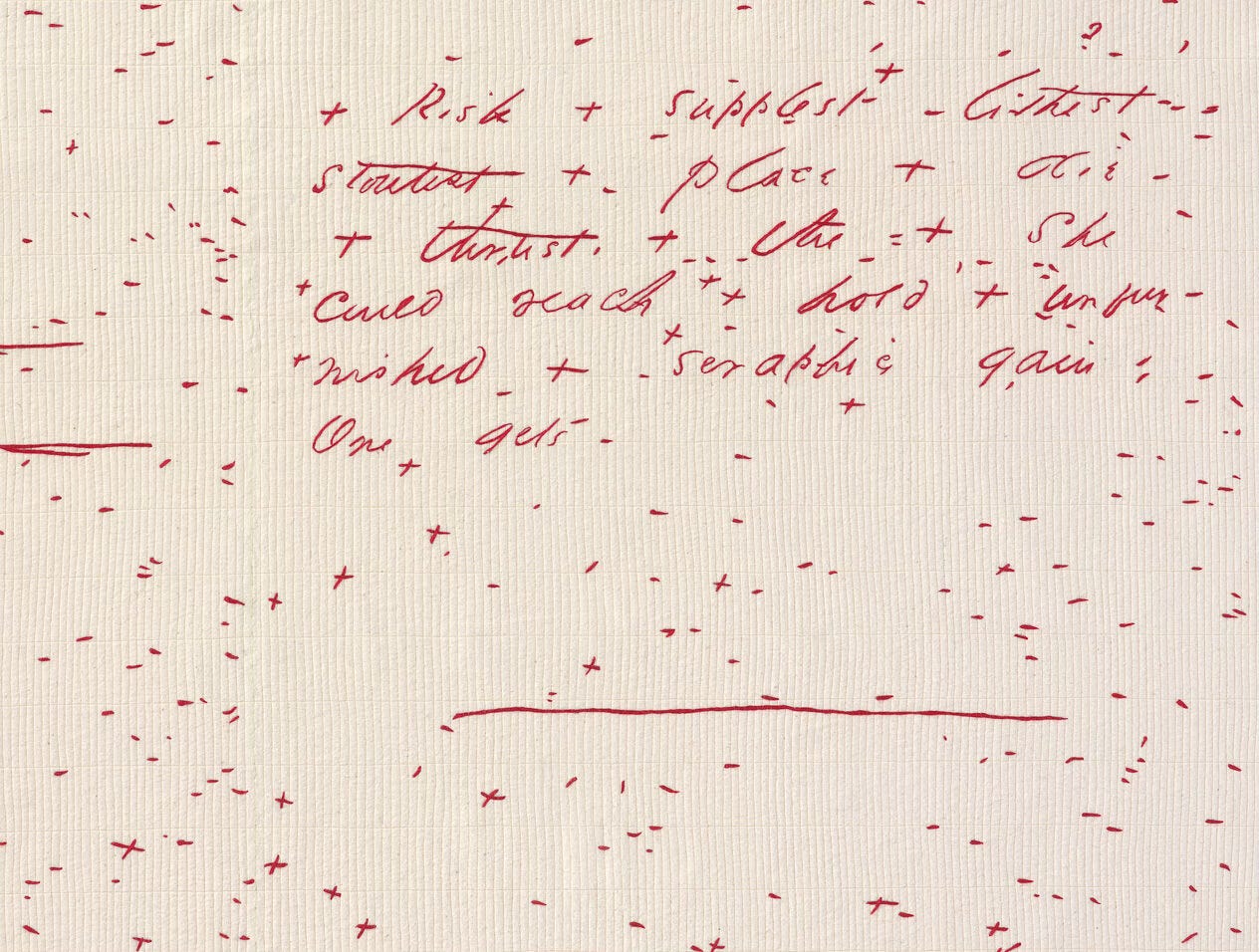
I was thinking of Emily Dickinson when I said this—how her proclivity for leaving multiple word substitutions in the margins of her poems, with neither word holding definitive primacy, generated effectively endless possible permutations for how each one could be read. “Choosing not choosing,” scholar Sharon Cameron called Dickinson’s refusal to make the final excision, to “kill her darlings.”
Triage logics, like viruses, are nothing if not adaptive; they excel at infiltrating even the thoughts and actions of those who seek to oppose them. They compel us to treat liberation as a scarce commodity, to run frantically from fire to fire, treating only the most readily visible, urgent or emergent of burns, while neglecting to care for those who have been inhaling the smoke—including, not least of all, ourselves. As avowed HIV and pro-Palestinian activists, artists, agitators, and doulas, we would be remiss to reproduce such hierarchies of importance and grievability, lest we burn ourselves and our movements out before we have truly begun. Collective liberation is not a choice affair: it demands that we not only spare but cherish our darlings, that we relegate absolutely nothing and no one to waste, that we cast our scalpels and scruples aside, and choose not choosing.